
|
The Laboratory for Adaptive Optics enables exploratory research
and development of adaptive optics systems for the next generation of high resolution astronomy instrumentation.
The Laboratory is a component of University of California Observatories, with facilities located on the UC Santa Cruz campus.
We develop, assemble, and deploy complex adaptive optics instruments for the world's
largest telescopes in support of UC Astronomy, including those at the Keck, Gemini, and Lick Observatories.
We have a close affiliation with the UC Center for Adaptive Optics where our educational and outreach activities
include hosting PhD thesis research, a summer school on adaptive optics, and seminars and workshops
in the AO related fields We actively solicit collaboration with industry and partner observatories
to pursue goals benefiting the astronomical AO community.
Major instruments developed in the LAO include:
ShaneAO
|
Laser Guide Star Adaptive Optics system for
the Shane Telescope on Mount Hamilton. LAO designed and constructed
this instrument in coordination with the Lick Optical Shops,
and commissioned the instrument in 2013 at Mt Hamilton.
|
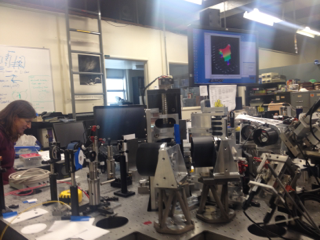
|
GPI
|
Gemini Planet Imager - An "Extreme" Adaptive
Optics system for imaging planets around nearby
stars. Developed in collaboration with Gemini and six
other institutuions, this instrument is now at the Gemini South 8-meter telescope
in Chile. LAO hosted the laboratory research and development of Extreme AO, MEMS, and
coronagraph concepts, and hosted the instrument's final integration and testing before
shipment to Chile.
GPI First Light press release. |

|
Read about our
laboratory facilities
Through the CfAO, we have hosted a series of
workshops on laser guidestars
Recent Publications by LAO Researchers
-
Gavel, D. T., Kupke, R., Rudy, A. R., Srinath, S., Dillon, D., & Poyneer, L. A.
(2016). Lick Observatory’s Shane telescope adaptive optics system (ShaneAO):
research directions and progress. Proc SPIE, V. 9909.
doi-link
-
Gavel, D. T. (2015). Second generation laser guide star adaptive optics for
astronomy: MEMS and fiber lasers lead the way. In Adaptive Optics: Analysis,
Methods and Systems, AO 2015. doi-link
-
Gavel, D., Kupke, R., Dillon, D., Norton, A., Ratliff, C., Cabak, J., & Pfister,
T. (2015). Laser guide star adaptive optics at Lick Observatory. In Adaptive
Optics for Extremely Large Telescopes 4 - Conference Proceedings.
doi-link
-
Rampy, R., Gavel, D., Rochester, S. M., & Holzlöhner, R. (2015). Toward
optimization of pulsed sodium laser guide stars. Journal of the Optical Society
of America B: Optical Physics, 32(12). doi-link
-
Gavel, D., Kupke, R., Dillon, D., Norton, A., Ratliff, C., Cabak, J., & Pfister,
T. (2014). ShaneAO : wide science spectrum adaptive optics system for the Lick
Observatory. Proc SPIE, 9148. doi-link
-
McGurk, R., Rockosi, C., Gavel, D., Kupke, R., Peck, M., Pfister, T., & Norton,
A. (2014). Commissioning ShARCS: The Shane adaptive optics infrared
camera-spectrograph for the Lick Observatory Shane 3-m telescope. Proc
SPIE, 9148.doi-link
- Gavel, D. (2005). Stability of Closed-Loop
Tomography Algorithms for Adaptive Optics. In Adaptive Optics: Analysis and
Methods/Computational Optical Sensing and Imaging/Information Photonics/Signal
Recovery and Synthesis Topical Meetings, p. AThA5.
doi-link
-
Thomas, S. J., Poyneer, L., De Rosa, R., Macintosh, B.,
Dillon, D., Wallace, J. K., & Goodsell, S. (2011).
Integration and test of the Gemini Planet Imager.
Proc SPIE, 8149.
doi-link
-
Macintosh, B. A., Graham, J. R., Palmer, D. W., Doyon, R., Dunn, J., Gavel, D.
T., & Soummer, R. (2008). The Gemini planet imager: From science to design to
construction. Proc SPIE, 7015. doi-link
Additional publications here
The LAO was initiated with a generous grant from the
Gordon and Betty Moore Foundation.
|